


(Die Abbildungen müssen nicht den tatsächlichen Produkten entsprechen)

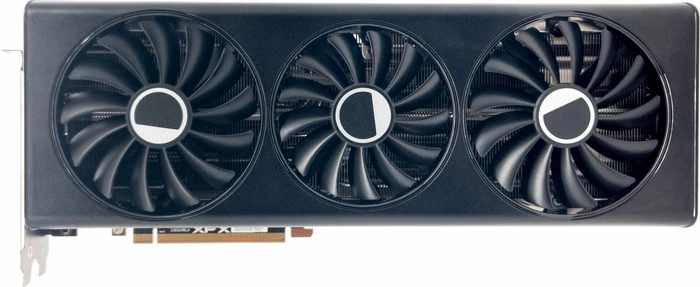
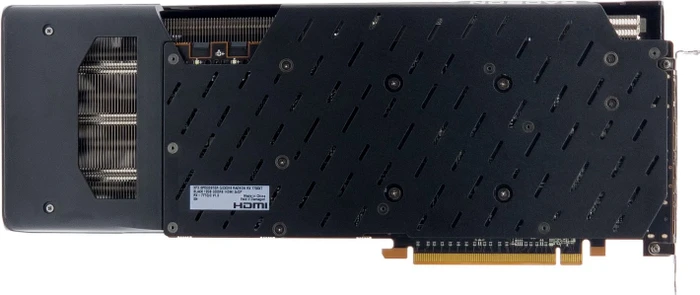
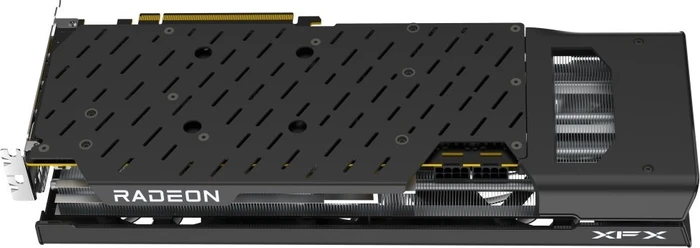
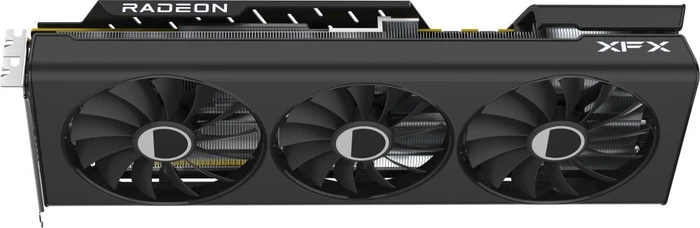
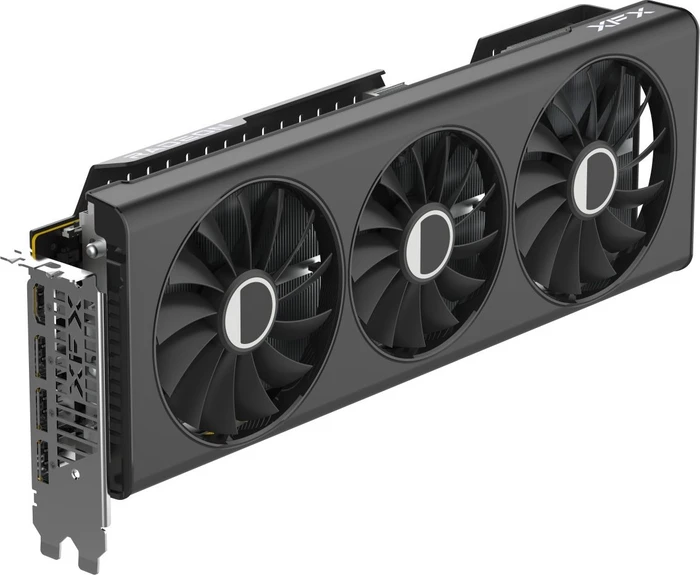
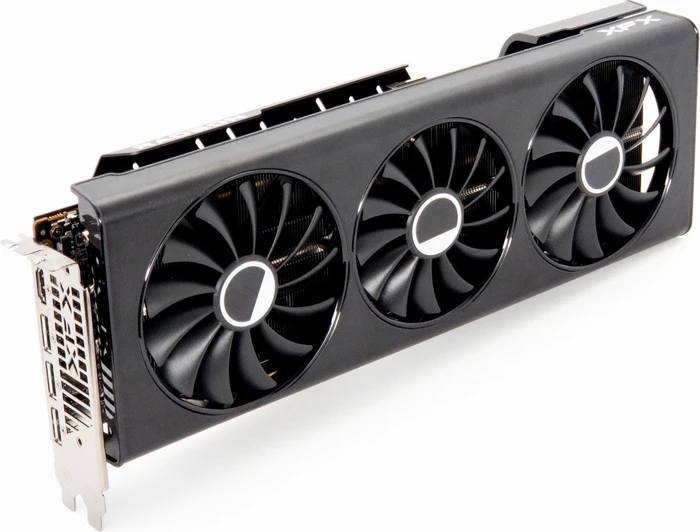
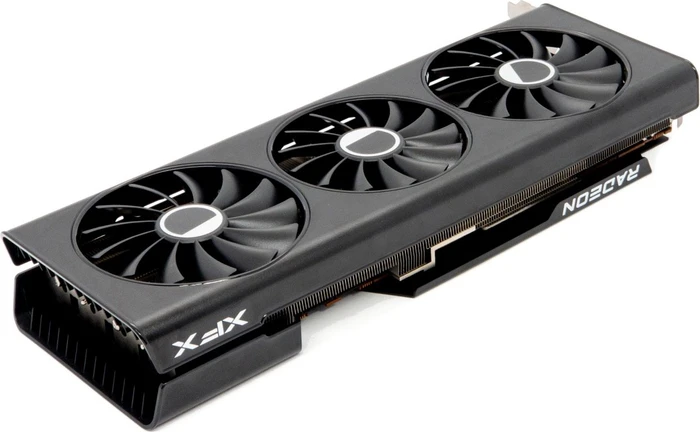
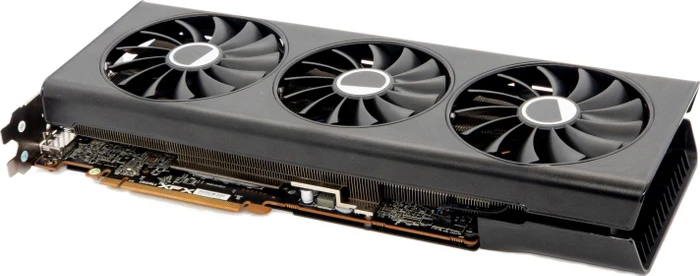
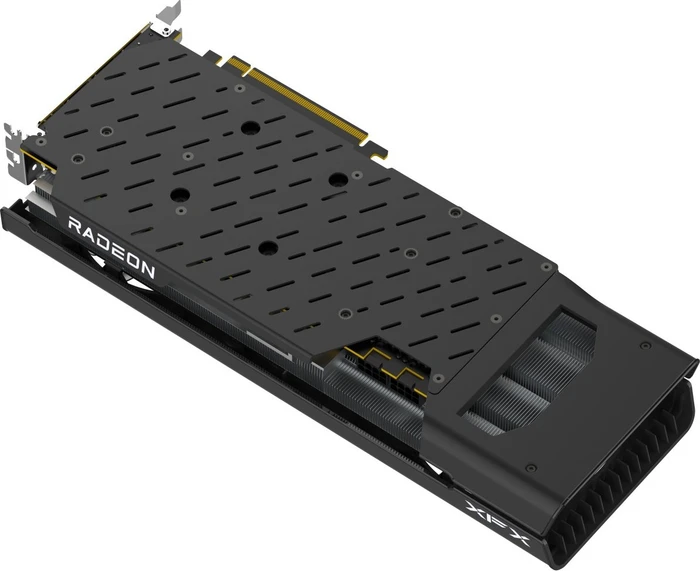
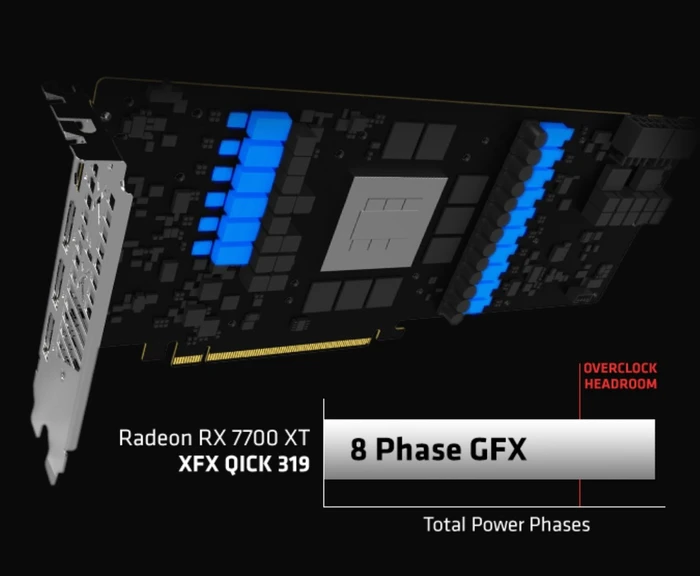
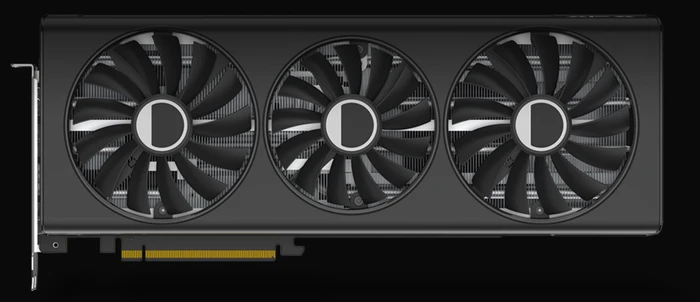
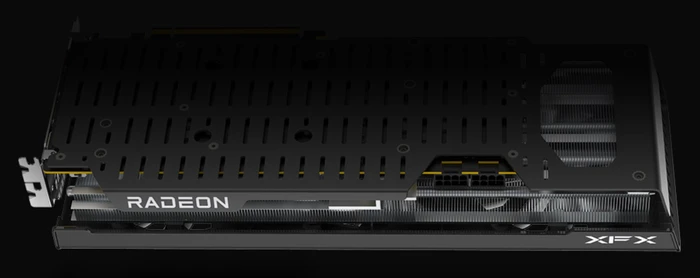


XFX Speedster QICK 319 Radeon RX 7700 XT Black Edition, 12GB GDDR6, HDMI, 3x DP
RX-77TQICKB9
- Modell
- AMD Radeon RX 7700 XT
- Speicher
- 12GB GDDR6, 192bit, 18Gbps, 2250MHz, 432GB/s
- Takt Basis
- 1785MHz
- Takt Boost
- 2276-2599MHz
- Übertaktung
- +55MHz Boost, +105MHz Game
- Kühlung
- 3x Axial-Lüfter (2x 110mm + 90mm)
- TDP/TGP
- 245W (AMD)
- Stromanschlüsse
- 2x 8-Pin PCIe
- Anschlüsse
- 1x HDMI 2.1, 3x DisplayPort 2.1 UHBR13.5
- Anbindung
- PCIe 4.0 x16
- Besonderheiten
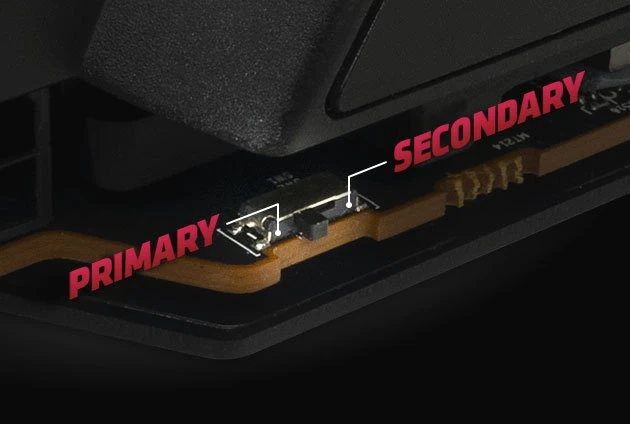
- Backplate, Dual BIOS Switch
- Gesamthöhe
- Triple Slot (2.5 Slots)
Es gibt derzeit keine Anbieter für dieses Produkt
(mit diesen Filterkriterien).
Bitte ggf. die Filterkriterien ändern.
Bitte ggf. die Filterkriterien ändern.
Ähnliche Produkte (Top-10 in PCIe)

ASUS Prime Radeon RX 9070 XT OC, PRIME-RX9070XT-O16G, 16GB GDDR6, HDMI, 3x DP
90YV0L71-M0NA00
ab
€ 779,90

ASUS Prime GeForce RTX 5070 Ti OC, PRIME-RTX5070TI-O16G, 16GB GDDR7, HDMI, 3x DP
90YV0MF0-M0NA00
ab
€ 1249,00

ASUS ROG Astral GeForce RTX 5090 OC, ROG-ASTRAL-RTX5090-O32G-GAMING, 32GB GDDR7, 2x HDMI, 3x DP
90YV0LW0-M0NA00
ab
€ 5949,00
ASUS Dual Radeon RX 9060 XT, DUAL-RX9060XT-16G, 16GB GDDR6, HDMI, 2x DP
90YV0LG2-M0NA00 / 90YV0LG2-M0AA00
ab
€ 499,90
MSI GeForce RTX 5080 16G Gaming Trio OC, G5080-16GTC, 16GB GDDR7, HDMI, 3x DP
V531-005R
ab
€ 1516,39

ASUS Dual GeForce RTX 5060 Ti OC, DUAL-RTX5060TI-O16G, 16GB GDDR7, HDMI, 3x DP
90YV0MH0-M0NA00
ab
€ 689,99

XFX Swift Radeon RX 9070 XT Triple Fan Gaming Edition, 16GB GDDR6, HDMI, 3x DP
RX-97TSWF3B9
ab
€ 777,99
MSI GeForce RTX 5090 32G Ventus 3X OC, G5090-32V3C, 32GB GDDR7, HDMI, 3x DP
V530-060R
ab
€ 5741,00

ASUS TUF Gaming GeForce RTX 5080 OC, TUF-RTX5080-O16G-GAMING, 16GB GDDR7, 2x HDMI, 3x DP
90YV0M30-M0NA00
ab
€ 1679,00
ASUS Prime GeForce RTX 5080 OC, PRIME-RTX5080-O16G, 16GB GDDR7, HDMI, 3x DP
90YV0LX0-M0NA00
ab
€ 1494,76
- Modell
- AMD Radeon RX 7700 XT
- Speicher
- 12GB GDDR6, 192bit, 18Gbps, 2250MHz, 432GB/s
- Takt Basis
- 1785MHz
- Takt Boost
- 2276-2599MHz
- Übertaktung
- +55MHz Boost, +105MHz Game
- Kühlung
- 3x Axial-Lüfter (2x 110mm + 90mm)
- TDP/TGP
- 245W (AMD)
- Stromanschlüsse
- 2x 8-Pin PCIe
- Anschlüsse
- 1x HDMI 2.1, 3x DisplayPort 2.1 UHBR13.5
- Anbindung
- PCIe 4.0 x16
- Besonderheiten
- Backplate, Dual BIOS Switch
- Gesamthöhe
- Triple Slot (2.5 Slots)
- Abmessungen
- 335x130x52mm (LxBxH)
- Bauform
- PCIe-Karte (full height)
- Slotblende
- full height
- GPU-Rechenleistung
- 71.88 TFLOPS (FP16), 35.94 TFLOPS (FP32), 1.12 TFLOPS (FP64)
- Chip-Daten
- Chip-Architektur
- AMD RDNA 3 (ab 2022/Q4)
- Chip-Bezeichnung
- Navi 32 (Navi 32 XL)
- Chip-Ausbau
- 90% aktive Recheneinheiten (54/60 CU)
- Chip-Konfiguration
- 54CU (3456SP/216TMU/96ROP), 54 RT-Cores, 2MiB L2-Cache
- Chip-Fertigung
- TSMC N5P (5nm)
- Chip-Größe
- 346mm², Multi-Chip-Modul (4 MCM-Chiplets), 28.1 Mrd. Transistoren
- Chip-Funktionen
- Raytracing, AMD Infinity Cache (64MiB), HDCP 2.3
- Chip-Verwendung
- Radeon RX 7800 XT
Radeon RX 7700 XT
Radeon PRO W7700 - API-Unterstützung
- DirectX 12 Ultimate (12_2) / Vulkan 1.3 / OpenCL 2.2 / OpenGL 4.6 / Shader Model 6.7
- Transcoding-Engine
- VCN 4.0, Info
- Encoding
- AV1, H.265, H.264
- Decoding
- AV1, H.265, H.264, VP9
- Multi-GPU-Anbindung
- -
- Veröffentlichung (Serie)
- 25.08.2023, Verkaufsstart: 06.09.2023, UVP: 449 USD (AMD)
- Grafik
- AMD Radeon RX 7700 XT - 12GB GDDR6 - Desktop
- Letztes Preisupdate
- -
- Gelistet seit
- 31.08.2023, 14:21
Laden ...
Bewertung für XFX Speedster QICK 319 Radeon RX 7700 XT Black Edition, 12GB GDDR6, HDMI, 3x DP
Teilen Sie uns Ihre Meinung zu XFX Speedster QICK 319 Radeon RX 7700 XT Black Edition, 12GB GDDR6, HDMI, 3x DP mit oder lesen Sie die Bewertungen unserer Mitglieder, Experten und anderer Websites zu dessen Varianten.Laden ...
-
 tomshardware.com: AMD Radeon RX 7700 XT Review: Stuck in the Middle (translate)Originalwertung: 3/5
AMD's RX 7700 XT gets stuck between the proverbial rock and hard place. The performance and features aren't bad, but it's priced far too close to the 7800 XT right now, not to mention competition from the previous generation RX 6800.
-
guru3d.com: XFX Radeon RX 7700 XT QICK 319 review (translate)
The XFX QICK 319 version of the Radeon 7700 XT 12GB represents an addition to the mid to high-range graphics range. Despite initial release delays, these GPUs possess significant shader functionalities and have 12GB GDDR6 graphics memory. Such specifications indicate potential compatibility and performance with WQHD monitor resolutions.

-
lanoc.org: XFX QICK 319 RX 7700 XT Black (translate)
In my review of the Sapphire RX 7700 XT pulse, we got a look at the 7700 XT’s stock-clocked performance and I was impressed with how it compared with the RTX 4060 Ti. That was no different this time with the XFX QICK 319 RX 7700 XT Black. It is overclocked and in a majority of our tests that translated to a small performance bump. 1440p performance was solid, not up into the same range as the new 7800 XT but perfect to pair with a 1440p 144Hz display while also having some capabilities at 4k should you need it. Blender performance is still not that impressive. Ray tracing performance isn’t caught up to Nvidia, but has improved from the last generation. Like with all of the AMD cards I have taken a look at today, the QICK 319 RX 7700 XT Black has standard PCIe power connections which means you can save money by reusing your older power supply if you have one or avoid having to use adapters. XFX’s design is similar to the XFX MERC 319 RX 7800 XT but the QICK 319 RX 7700 XT Black doesn’t have the silver trim that the MERC has making it a simple blacked-out card design. The only fault there is that the fans have the same silver and black accents on them that the MERC had which spoils the blacked-out look. The cooler on the QICK 319 RX 7700 XT Black handled things fine but there wasn’t much headroom left over, it didn’t perform much better when going from the stock fan profile to 100% fan speed. Our noise testing had it up near the top of our charts in all three tests as well which is the opposite of what I saw from the MERC. In the end, the large card did improve on what I saw from the Sapphire 7700 XT Pulse, but I do wish that XFX had a more compact design like the Pulse as well. For pricing the QICK 319 RX 7700 XT Black should be priced between 459.99 and 469.99 and for comparison the base MSRP of the 7700 XT is $449. AMD didn’t leave much room between the 7700 XT and the 7800XT which is the biggest downside to the 7700 XT. It isn’t a bad performing GPU, but once you start looking at a card like the QICK 319 RX 7700 XT Black you get close to a stock-clocked RX 7800 XT quick. The QICK 319 RX 7700 XT Black like with all of the other 7700 XT and 7800 XT’s does come with Starfield Premium Edition which is a $99 value. If you were already planning on picking up the game that isn’t a bad value add.
-
eteknix.com: AMD Radeon RX 7700 XT 12GB Graphics Card Review Featuring XFX QICK 319 (translate)
For me, I’m torn. I really like the 7700 XT, because it does give a good uplift from the previous generation, and also sits at a price segment that really doesn’t have any competition, but then AMD have come along and beaten it down a little with its bigger brother; the 7800 XT and I get it, because if the 7800 XT was more expensive, it wouldn’t make any sense, but with $50 separating the two, it’s a tough one. I guess, you could say that if your budget is $450 and not a penny more, then it’s the wisest and smartest choice, but if you can stretch a little further, then the 7800 XT is a no-brainer. In comparison to NVIDIA, it has really shown how out of touch team green is with the audience and general consumer base, and even with the price drops on the RX 6700 and 6700 XT, this newer card still comes in pretty damn favourable. Sure, the older cards offer superior bang for buck in terms of cost per frame, but a newer product will always be that little bit higher because you have to pay the early adopter tax, but it’s not that much more, and with frame generation on the horizon, I feel that the 7700 XT is only going to get even better as time goes on and it’s allowed some time to mature, much like most AMD products have done historically.
-
techpowerup.com: XFX Radeon RX 7700 XT Qick 319 Review (translate)
While the PCB design might help explain the pricing of 7700 XT, it doesn't change the fact that this card appears fairly expensive. Its price/performance ratio is worse than that of the faster RX 7800 XT, which is usually a red flag. While performance compared to the $400 RTX 4060 Ti 8 GB is clearly better in rasterization, RT performance is no clear win, and NVIDIA has DLSS 3 to offer. AMD's bigger 12 GB framebuffer doesn't bring any tangible improvements, so I wouldn't be surprised if there's plenty of people out there that will buy the $50 cheaper NVIDIA offering, also because of its lower barrier of entry. AMD knows that, too, which makes me wonder why they didn't at least price the RX 7700 XT at $430, to move further away from the psychologically important $450 price point. Radeon RX 6800 non-XT currently sells for $430, which makes both cards even in terms of Performance per Dollar. The XFX Qick 319 sells for $470, which makes the offering even less interesting. I'm not sure who would buy a $470 RX 7700 XT, if they can buy a RX 7800 XT for $500, even if it's a stock-clocked model with a slightly weaker cooler. PowerColor's RX 7800 XT comes at $500, so you actually have an excellent option here, if it's available in your region. Grabbing a previous-generation card at similar pricing makes little sense to me, even though it's a 16 GB vs 12 GB trade. RTX 3070 Ti for $390 could be an option, it's faster than RTX 4060 Ti in both ray tracing and rasterization, but lacks DLSS 3, which makes the $400 RTX 4060 Ti the better choice for most users. If you don't care about DLSS 3, but want DLSS 2 for maximum game compatibility, then RTX 3080 could be a viable choice, it'll be 30% faster in RT, 12% faster in raster, for a modest $20 more (or $470). Probably the strongest competition for RX 7700 XT is the RX 7800 XT. For an additional $50 (or 11%) you get 16% in extra performance, in both RT and raster, and an additional 4 GB of VRAM. Maybe that's AMD's plan, to drive more sales to the RX 7800 XT, but right now, the RX 7700 XT isn't priced aggressively enough to make NVIDIA rethink their pricing strategy for RTX 4060 Ti. What definitely works in favor of the RX 7700 XT is that AMD is bundling Starfield for free with their cards.

-
overclock3d.net: XFX RX 7700 XT Qick 319 Review (translate)
Certainly as a sub £500 card it ticks an awful lot of boxes. Designed squarely for 1080 and 1440 gamers, it is capable of pushing well past the 60 FPS mark in all of our titles, and quite often far beyond that number too. Where we think it really shines is in the same place that other AMD Radeon cards do, and is the same benefit DLSS provides to the more affordable Nvidia cards, namely FidelityFX Super Resolution, or FSR to its friends. Just go back and have a look at the effect it has in a title such as Call of Duty, where framerate can be the difference between victory and ignominious defeat, and you'll see that AMD have really nailed the latest iteration of their FSR technology. The RX 7700 XT might have a little less hardware than the RX 7800 XT, but it still has plenty to do all the things this card is targeted towards.
- Serienübergreifende Testberichte
-

-
-
-
-
-
-
Alle Angaben ohne Gewähr. Die gelisteten Angebote sind keine verbindlichen Werbeaussagen der Anbieter.
* Preise in Euro inkl. MwSt. zzgl. Versandkosten. Bei der Auswahl von "inkl. Versand" beinhaltet der dargestellte Preis die Kosten für den Versand. Die nicht angeführten Kosten in andere Länder entnimm bitte der Website des Händlers. Bei Sortierung nach einer anderen als der Landeswährung des Händlers basiert die Währungsumrechnung auf einem von uns ermittelten Tageskurs, der womöglich nicht mit dem im Shop angegebenen Preis exakt übereinstimmt. Bitte bedenke außerdem, dass die angeführten Preise periodisch erzeugte Momentaufnahmen darstellen und technisch bedingt teilweise veraltet sein können. Insbesondere sind Preiserhöhungen zwischen dem Zeitpunkt der Preisübernahme durch uns und dem späteren Besuch dieser Website möglich. Händler haben keine Möglichkeit die Darstellung der Preise direkt zu beeinflussen und sofortige Änderungen auf unserer Seite zu veranlassen. Der maßgebliche Preis für den Verkauf durch den Händler ist der tatsächliche Preis des Produkts, der zum Zeitpunkt des Kaufs auf der Website des Händlers steht.
Letzte Aktualisierung:
Der heise Preisvergleich ist ein Angebot in Kooperation mit der Preisvergleich Internet Services AG (geizhals.de). Die Redaktion von heise online hat keinen Einfluss auf das Angebot. Anfragen bitten wir daher direkt an geizhals.de zu stellen.
Fragen, Kritik und Anregungen bitte per E-Mail oder im Forum. Händler können sich hier anmelden. Alle Angaben ohne Gewähr.
Weitere Kontaktmöglichkeiten zu geizhals.de findst du hier oder telefonisch unter: +43 1 581 16 09