


(Die Abbildungen müssen nicht den tatsächlichen Produkten entsprechen)


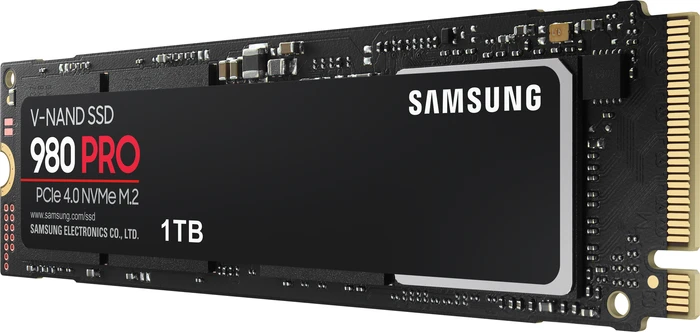
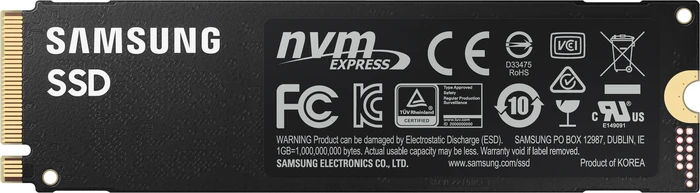

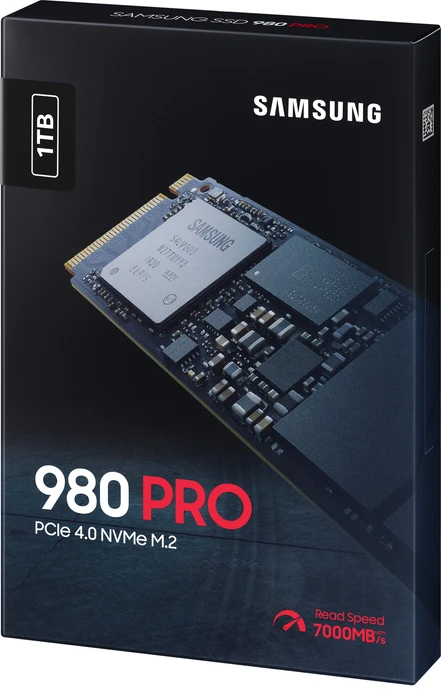
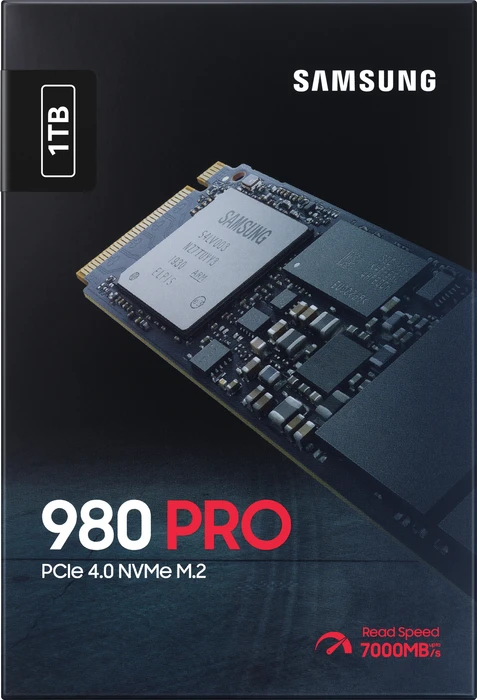
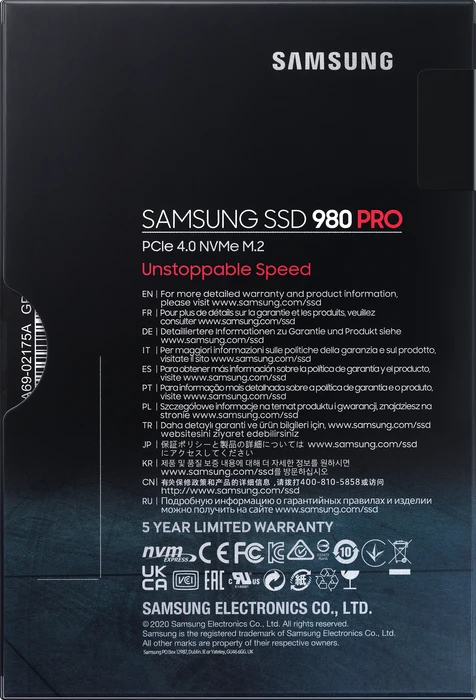
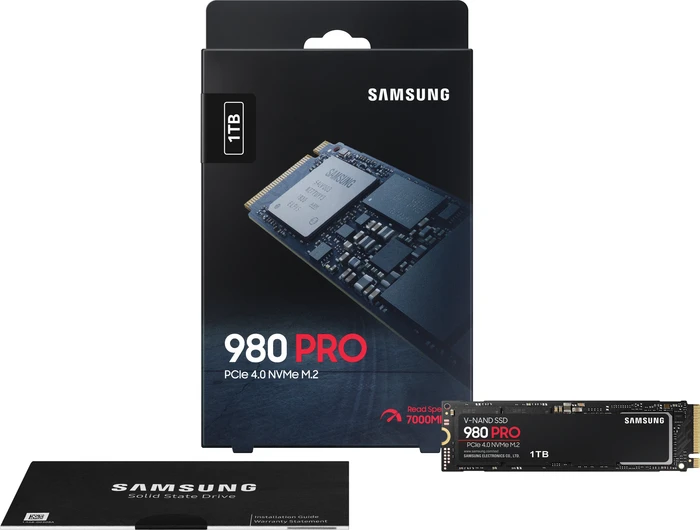


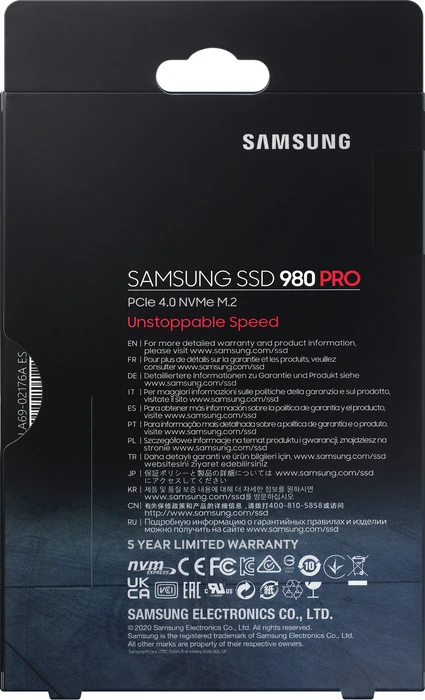


Samsung SSD 980 PRO 1TB, M.2 2280 / M-Key / PCIe 4.0 x4
MZ-V8P1T0BW / MZ-V8P1T0B
- Kapazität
- 1TB (entspricht ca. 931.32GiB bzw. 0.91TiB, weiterführende Informationen)
- Bauform
- Solid State Module (SSM)
- Formfaktor
- M.2 2280
- Schnittstelle
- M.2/M-Key (PCIe 4.0 x4)
- Lesen
- 7000MB/s
- Schreiben
- 5000MB/s (2000MB/s TLC)
- IOPS 4K
- 1000K lesend, 1000K schreibend
- Speichermodule
- 3D-NAND TLC, Samsung, 128 Layer (V-NAND v6)
- TBW
- 600TB, entspricht 600 Schreibzyklen (TBW/Kapazität)
- Zuverlässigkeitsprognose
- 1.5 Mio. Stunden (MTBF)
- Controller
- Samsung Elpis/S4LV003, 8 Kanäle
- DRAM-Cache
- ja, 1GB LPDDR4
Es gibt derzeit keine Anbieter für dieses Produkt
(mit diesen Filterkriterien).
Bitte ggf. die Filterkriterien ändern.
Bitte ggf. die Filterkriterien ändern.
Ähnliche Produkte (Top-10 in Solid State Drives (SSD))

Samsung SSD 990 PRO 2TB, M.2 2280 / M-Key / PCIe 4.0 x4
MZ-V9P2T0BW
ab
€ 325,47

Kingston NV3 NVMe PCIe 4.0 SSD 1TB, M.2 2280 / M-Key / PCIe 4.0 x4
SNV3S/1000G
ab
€ 143,99

Lexar NM790 2TB, M.2 2280 / M-Key / PCIe 4.0 x4
LNM790X002T-RNNNG
ab
€ 279,99

Western Digital WD_BLACK SN7100 NVMe SSD 1TB, M.2 2280 / M-Key / PCIe 4.0 x4
WDS100T4X0E-00CJA0 / WDBELG0010BBK-WRSN
ab
€ 164,90

KIOXIA EXCERIA PLUS G3 SSD 1TB, M.2 2280 / M-Key / PCIe 4.0 x4
LSD10Z001TG8 / LSD10Z001TC8
ab
€ 139,90

Samsung SSD 9100 PRO 2TB, M.2 2280 / M-Key / PCIe 5.0 x4
MZ-VAP2T0BW
ab
€ 369,99
Verbatim Vi3000 PCIe NVMe SSD 1TB, M.2 2280 / M-Key / PCIe 3.0 x4
49375
ab
€ 115,00
Lexar NM790 4TB, M.2 2280 / M-Key / PCIe 4.0 x4
LNM790X004T-RNNNG
ab
€ 460,00

Western Digital WD_BLACK SN850X NVMe SSD 2TB, M.2 2280 / M-Key / PCIe 4.0 x4
WDS200T2X0E-00BCA0 / WDBB9G0020BNC-WRSN
ab
€ 339,00

Samsung SSD 990 PRO 1TB, M.2 2280 / M-Key / PCIe 4.0 x4
MZ-V9P1T0BW
ab
€ 203,90
- Kapazität
- 1TB (entspricht ca. 931.32GiB bzw. 0.91TiB, weiterführende Informationen)
- Bauform
- Solid State Module (SSM)
- Formfaktor
- M.2 2280
- Schnittstelle
- M.2/M-Key (PCIe 4.0 x4)
- Lesen
- 7000MB/s
- Schreiben
- 5000MB/s (2000MB/s TLC)
- IOPS 4K
- 1000K lesend, 1000K schreibend
- Speichermodule
- 3D-NAND TLC, Samsung, 128 Layer (V-NAND v6)
- TBW
- 600TB, entspricht 600 Schreibzyklen (TBW/Kapazität)
- Zuverlässigkeitsprognose
- 1.5 Mio. Stunden (MTBF)
- Controller
- Samsung Elpis/S4LV003, 8 Kanäle
- DRAM-Cache
- ja, 1GB LPDDR4
- Protokoll
- NVMe 1.3c
- Datenschutzfunktionen
- 256bit AES, TCG Opal 2.0
- Leistungsaufnahme
- 8.9W (maximal), 6.2W (Betrieb), 35mW (Leerlauf), 5mW (Schlafmodus)
- Abmessungen
- 80x22x2.38mm (ohne Kühlkörper)
- Besonderheiten
- L1.2 Low-Power-Standby, dynamischer SLC-Cache (6-36GB)
- Garantie
- 5 Jahre (oder bis Erreichen der TBW)
- Letztes Preisupdate
- -
- Gelistet seit
- 30.08.2020, 10:14
-
Stand: 19.04.2022 .pdf [363.57 KB]
-
Stand: 29.11.2023 .pdf [203.04 KB]
-
Stand: 29.11.2023 .pdf [3.05 MB]

Laden ...
232 Bewertungen für Samsung SSD 980 PRO 1TB, M.2 2280 / M-Key / PCIe 4.0 x4
Teilen Sie uns Ihre Meinung zu Samsung SSD 980 PRO 1TB, M.2 2280 / M-Key / PCIe 4.0 x4 mit oder lesen Sie die Bewertungen unserer Mitglieder, Experten und anderer Websites zu dessen Varianten.Laden ...
-
 heise.de (techstage): Samsung SSD 980 Pro im Test: Schnelle M.2-SSD mit PCI Express 4.0Originalwertung: 4.5/5
Bis zu 6900 MByte/s verspricht die Samsung SSD 980 Pro mit 500 GByte Speicherplatz. TechStage schickt die M.2-NVMe durch den Benchmark.

-
myc-media.de: Samsung – 980 PRO M.2 NVMe SSD im TestOriginalwertung: 93/100
Mit der 980 PRO hat Samsung sein Sortiment um eine High-End M.2 SSD erweitert, welche dank des schnellen Controllers in Kombination mit den eingesetzten 3-bit MLC V-NAND sowie der PCIe 4.0 x4 Anbindung eine sehr hohe Geschwindigkeit erreichen kann.

-
 servethehome.com: Samsung 980 Pro 1TB NVMe M.2 SSD Review (translate)Originalwertung: 8.9/10
Today the Samsung 980 Pro 1TB is $155 online. That price point is very close to other top-end drives like the WD Black SN850, Sabrent Rocket 4 Plus, and Seagate FireCuda 530. While the performance of the 980 Pro is a minor step behind some of the other offerings, it is not so far behind that most users will notice the difference so I think this price is mostly justified.
-
thinkcomputers.org: Samsung 980 Pro PCIe 4.0 NVMe Solid State Drive Review (translate)Originalwertung: 9/10
There is a reason Samsung is one of the major players in the M.2 NVMe market. The always seem to exceed the competition and offer their products at competitive prices. That is what you are getting with the 980 Pro. While Samsung was late to the Gen4 game, it was definitely worth the wait. The 980 Pro is the fastest solid state drive that we’ve tested to date! Offering speeds that are far beyond many of its other Gen4 siblings. With both X570 and B550 platforms offering Gen4 compatibility adding a 980 Pro is a no-brainer. Another thing that I was really impressed with was Samsung’s Magician software. This was actually the first time that I’ve ever used it and I have to say it is the best SSD Toolbox software that I’ve used. It is extremely user-friendly and allows beginners as well as advanced users see what is going on with their drive, do things like secure erase, and more. Like most Gen4 drives if you are going to be using the 980 Pro without a heatsink in some cases it is going to overheat and thermally throttle. The drive does not come with a heatsink, although most motherboards do. I honestly think it would be hard to find an X570 or B550 board without M.2 heatsinks, but it is worth mentioning that if you don’t run the drive with a heatsink you could run into thermal issues. Samsung has done a great job with price on this drive too. The 512GB version that we reviewed today is selling for $139.99 at our favorite online retailer. Samsung also backs the drive with a 5-year warranty. Overall ThinkComputers gives the Samsung 980 Pro PCIe 4.0 NVMe Solid State Drive a 9 out of 10 score and our Recommended Award.
-
kitguru.net: Samsung SSD980 PRO 1TB Review (translate)Originalwertung: 9/10
It’s been a long old while since we’ve seen a high-end Samsung NVMe SSD and it has certainly been worth the wait as the SSD980 PRO has put the company firmly back in the spotlight in the high performance consumer market space.

-
pcworld.com: Samsung 980 Pro NVMe SSD review: PCIe 4.0 for the win (translate)Originalwertung: 4.5/5
The Samsung 980 Pro is here to take back the crown—and then some. While its predecessor, the 970 Pro, won and eventually lost its SSD performance title to hotter competition, this latest generation buries them all. Of course, to witness the greatness, you’ll need a computer with the PCIe 4.0 device interface, which currently means late-generation AMD Ryzen. With PCIe 3.0, the 980 Pro is still excellent, but merely on a par with the top competition.
-
youtube.com:
Micron 3400 vs SAMSUNG 980 PRO - Gute Alternative von MICRON zu besserem Preis?
-
allround-pc.com: Samsung SSD 980 PRO im Test: PCIe-4.0-Monster zum Sparpreis?
Mit der SSD 980 PRO setzt Samsung ohne Frage einen neuen Leistungsstandard im SSD-Segment. Der Wechsel auf die PCIe 4.0-Schnittstelle wird mit enormen Datenraten von deutlich über 6,7 GB/s beim Lesen belohnt. Insgesamt ist die SSD 980 PRO ohne jeden Zweifel ein Laufwerk für Enthusiasten, das als solches ein sehr rundes Gesamtpaket abgibt und damit unsere Empfehlung erhält.

-
-
techadvisor.co.uk: Samsung 980 Pro Review: PCIe 4.0 NVMe is Here (translate)
There are plenty of positive things about the Samsung 980 Pro, but much of that falls into the category of ‘be careful what you wish for’. On paper, the doubling of bandwidth for M.2 NVMe storage devices looked like slamdunk. But, that thinking failed to consider that the power consumption of this throughput will have a significant thermal impact and that NAND technology isn’t twice the speed this year as it was in 2019. Suppose you occasionally launch applications and write data. In that case, the Samsung 980 Pro will perform admirably, but if you hit it hard repeatedly, the temperature will rise, and without active cooling, it will eventually throttle. There is no free lunch in thermodynamics, with unrelenting use temperatures grow, and eventually, the throughput speeds will be lower than a PCIe 3.0 drive. And, the NAND technology on this drive only looks this fast because it has 1GB of LPDRR4 caching it, but once that and the SLC is fully saturated we see the underlying performance of the Samsung 12-Layer V-NAND 3-bit MLC, and that’s much less. These things said, at least Samsung built a controller for this device that can use most of the bandwidth of PCIe 4.0, where many early PCIe 4.0 NVMe designs opted to use the Phison E16 controller that can only hit 5,000MB/s reading, and 4,800MB/s writes. However, Phison has worked on the E16 and created the E18, a new controller that may eclipse the Samsung Elpis, and has already incorporated it into the Sabrent Rocket 4 Plus. Hopefully, we’ll review one of those soon to see how it compares. There are scenarios where the Samsung 980 Pro delivers precisely the performance boost that users want, but it isn’t across the board by any means. It’s for you to decide if that fits your use model and to achieve those brief highs, it is worth the extra 80% cost over the Samsung 970 Evo 500GB or similar. Price is a serious issue here, because who in their right mind would buy a 980 Pro 1TB drive from Samsung when the same money might get them 2TB of PCIe 3.0 SSD elsewhere? The Samsung 980 Pro is undoubtedly the PCIe 4.0 NVMe drive by which all others are judged at this moment, but that doesn’t mean we should all rush out and get one, and a system to exploit it. If you do, it's worth avoiding the smaller capacities.
-
overclock3d.net: Samsung 980 Pro 1TB Review (translate)
It's been quite a month for us here at OC3D. We've only just got over the shock of the game-changing performance from the new Nvidia RTX 3080 and Samsung turn up with a drive which is similarly epoch-making. For a long time we've said that PCI Express 3.0 drives had pretty much topped out, and that whilst we'd buy the Samsung with our own money, if you just wanted performance you could almost buy any of them and be happy. Then the PCI Express 4.0 drives appeared and gave us 5 GB/s read transfer speeds and 4 GB/s write speeds, and made us chuckle at how impressive they were. We thought that was about the upper limit of the PCI Express 4.0 bandwidth as we'd tested four drives and they all gave us approximately identical levels of performance.
-
guru3d.com: Samsung 980 Pro 1TB NVMe SSD review (translate)
The Samsung 980 PRO series is an impressive drive, however, it managed to impress me less than the release of the 970 PRO. The focus for Samsung has been clear, reach a peak read speed of ~7 GB/sec and ~5 GB/for writes. You'll only hit these numbers in very specific workloads, mostly sustained and linear writes. Also if you want to copy at 5 GB/sec to the Pro, surely your host/client setup should be the same. So you'll be hardpressed to reach these numbers in a real-world scenario. When we look at trace performance and other write workloads, the performance still is terrific, but more in line with a premium PCIe gen 3.0 or 4.0 SSD. That is the reality.

- Serienübergreifende Testberichte
-
-
-
-
-
-
-
-
-
-
Alle Angaben ohne Gewähr. Die gelisteten Angebote sind keine verbindlichen Werbeaussagen der Anbieter.
* Preise in Euro inkl. MwSt. zzgl. Versandkosten. Bei der Auswahl von "inkl. Versand" beinhaltet der dargestellte Preis die Kosten für den Versand. Die nicht angeführten Kosten in andere Länder entnimm bitte der Website des Händlers. Bei Sortierung nach einer anderen als der Landeswährung des Händlers basiert die Währungsumrechnung auf einem von uns ermittelten Tageskurs, der womöglich nicht mit dem im Shop angegebenen Preis exakt übereinstimmt. Bitte bedenke außerdem, dass die angeführten Preise periodisch erzeugte Momentaufnahmen darstellen und technisch bedingt teilweise veraltet sein können. Insbesondere sind Preiserhöhungen zwischen dem Zeitpunkt der Preisübernahme durch uns und dem späteren Besuch dieser Website möglich. Händler haben keine Möglichkeit die Darstellung der Preise direkt zu beeinflussen und sofortige Änderungen auf unserer Seite zu veranlassen. Der maßgebliche Preis für den Verkauf durch den Händler ist der tatsächliche Preis des Produkts, der zum Zeitpunkt des Kaufs auf der Website des Händlers steht.
Letzte Aktualisierung:
Der heise Preisvergleich ist ein Angebot in Kooperation mit der Preisvergleich Internet Services AG (geizhals.de). Die Redaktion von heise online hat keinen Einfluss auf das Angebot. Anfragen bitten wir daher direkt an geizhals.de zu stellen.
Fragen, Kritik und Anregungen bitte per E-Mail oder im Forum. Händler können sich hier anmelden. Alle Angaben ohne Gewähr.
Weitere Kontaktmöglichkeiten zu geizhals.de findst du hier oder telefonisch unter: +43 1 581 16 09